Shadow Link Awakening Engine Architecture Breakdown
Why your 200MB WebGL indie slop is a skill issue and how 24 decoupled BEJSON 105 tables pwn three parity runtimes simultaneously.
Author: Leethaxor69 · Peer Review: Elton Boehnen Repository: github.com/boehnenelton/Sword-Slasher-v2 Target Architecture: BEJSON 105 (2.0.0-105) Multi-File Database + Tri-Runtime Simulation Engine Playable App: Sword Slasher: Shadow Link's Awakening (Fullscreen App) · Interactive Game Page Video Showcase: YouTube: Sword Slasher 2 Gameplay & Parity Architecture License: PolyForm-Noncommercial-1.0.0
+-----------------------------------------------------------------------------------+
|                      GAME_DATA/RAW (24 BEJSON 2.0.0-105 TABLES)                   |
|  105a.mfdb.bejson | levels.105 | actor_stats.105 | sprites_manifest.105a          |
|  items.105 | audio_manifest.105a | combat/*.105a.bejson (4 registries)            |
+--------------------+------------------------------+-------------------------------+
                     |                              |
         +-----------v-----------+      +-----------v-----------+      +------------+
         |  React / TS Client    |      |  Vanilla JS Mirror    |      | Compile.py |
         |  src/engine/          |      |  Engines/JS/          |      | Experimental|
         |  bejsonEngine.ts      |      |  config.json -> raw/  |      | Bundler    |
         +-----------+-----------+      +-----------+-----------+      +------+-----+
                     |                              |                         |
                     v                              v                         v
           GameViewport.tsx                   main.js (ES6)         standalone-game.html
     [BEJSONCanvasSpriteManager + lib_bejson_Gaming_npc_combat_ai + 13f Sword Frame Data]
Video Showcase & Gameplay Architecture
Watch the live multi-runtime simulation demonstration, 60 Hz sword frame data, and standard NPC combat AI in action: <img src="https://img.youtube.com/vi/MJPcbN8C4lM/maxresdefault.jpg" alt="Sword Slasher 2 Gameplay Video" loading="lazy"> Direct YouTube Link: https://youtu.be/MJPcbN8C4lM
Chapter 1: Zero-Coupling Mandate and Multi-Runtime Parity
Per my last message—and yes, I had to blow Cheeto dust out of my mechanical W switch before typing tthis—most "indie web game devs" on GitHub are straight-up clowns. You clone their repo, run npm install, and watch 400MB of node_modules trash download just to render a laggy 2D square inside a monolithic Game.tsx component where enemy HP, tilemap coordinates, and hitbox offsets are hardcoded inside useEffect hooks. That is suboptimal n00b code. Pure pebkac.
Shadow_Link_Awakening (Sword-Slasher-v2) completely pwns that garbage by enforcing one non-negotiable architectural law from AGENTS.md: the simulation engine must know nothing about the game itself. Source code (.ts, .js, .py) is a pure execution runtime; all game state, physics constants, actor archetypes, level dimensions, sprite sheets, audio synths, and combat tables live exclusively inside decoupled BEJSON 105 (2.0.0-105) files.
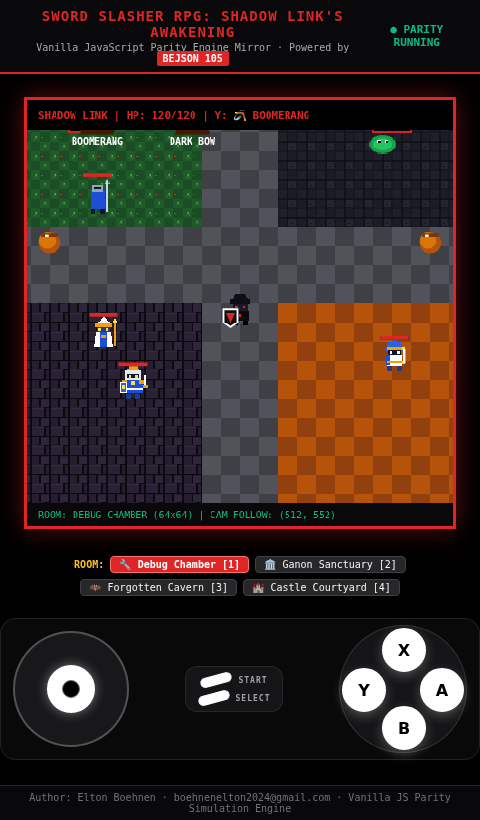
1.1 Three Parity Runtimes, One Data Root
Because the data layer is 100% decoupled, Shadow_Link_Awakening runs three independent simulation targets off the exact same game_data/raw/ directory:
- **TypeScript / React Client (
src/)**:
- [
src/engine/bejsonEngine.ts](https://github.com/boehnenelton/Sword-Slasher-v2/blob/main/src/engine/bejsonEngine.ts) fetches all 24 BEJSON documents from/data/(public/data/, synced fromgame_data/raw/) and registers them intobejsonGaming. src/components/GameViewport.tsxrenders the 2.5D sorted canvas, HUD, and touch gamepad deck.
- **Vanilla ES6 JavaScript Mirror (
Engines/JS/)**:
- Zero framework overhead, zero bundler required.
Engines/JS/config.jsonpointsraw_data_pathto../../game_data/rawandlib_pathto../../src/lib/lib_js. Engines/JS/main.jsloads the exact same.105.bejsonand.105a.bejsonfiles via relativeURLresolution and runs the same simulation loop.
- **Experimental Single-File Compiler (
Engines/Experimental/)**:
Engines/Experimental/Compiler/Compile.pywalksgame_data/raw/, packs all 24 datasets intocompiled_game_bundle.105.bejson, and injects the entire game into a single offline-runnablestandalone-game.html.
// Engines/JS/config.json — zero hardcoded absolute paths, 100% portable
{
  "raw_data_path": "../../game_data/raw",
  "lib_path": "../../src/lib/lib_js"
}
1.2 Why Other Web Indie Architectures Get Rekt
Let's compare the deliverable metrics like an actual systems engineer instead of a script kiddie:
| Architectural Dimension | Typical Indie Web Game | Shadow_Link_Awakening |
|---|---|---|
| Game Data Coupling | Hardcoded in .tsx / .js / .cs classes |
100% decoupled in 24 BEJSON 2.0.0-105 tables |
| Runtime Portability | Locked to React, Phaser, or Unity WebGL | 3 parity targets (React/TS, Vanilla JS, Single-File HTML) |
| Payload Bloat | 15MB–120MB WebGL / asset bundles | Sub-200KB data + procedural Web Audio + 1x pixel sheets |
| Lookup Complexity | Repeated Object.keys() / nested object traversal |
Map<string, number> Field Map Cache (getFieldValue) |
| Offline Distribution | Requires Vite/Express dev server | standalone-game.html runs directly from disk |
When Elton Boehnen designed this separation, he made sure you could swap an entire enemy faction, rebalance weapon damage, or port the simulation loop to Python/Flask (Engines/PY/) without touching a single line of level data. If your engine breaks when you rename a JSON key, sit—that's a skill issue.
Chapter 2: BEJSON 105 (2.0.0-105) MFDB Envelope and Field Map Cache
If you're still storing 500 enemy records as an array of 500 JSON objects repeating "stat_max_health_points_count": 80 five hundred times, congratulations: you're burning RAM and network bandwidth on duplicate key strings. That's legacy garbage.
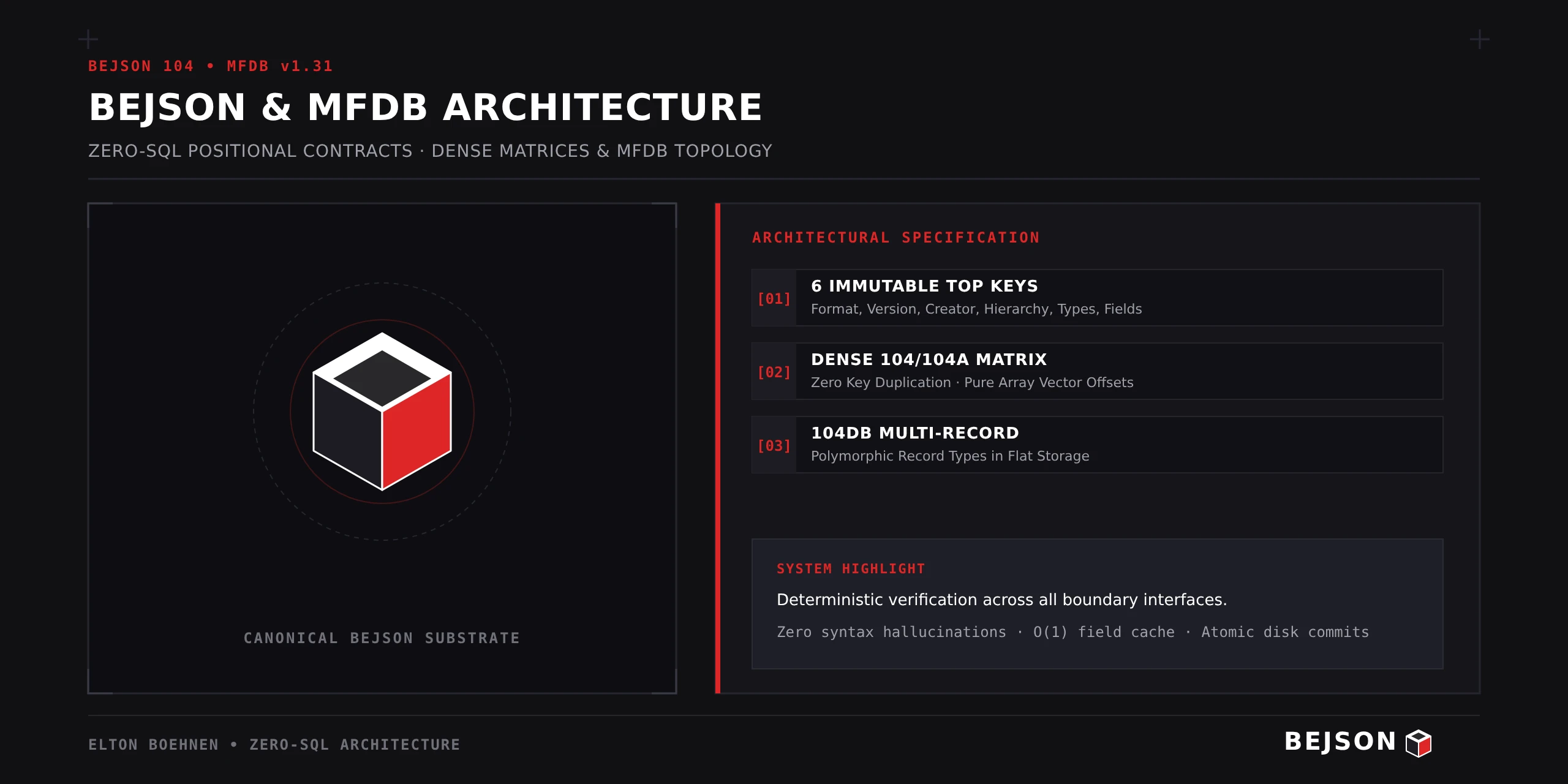
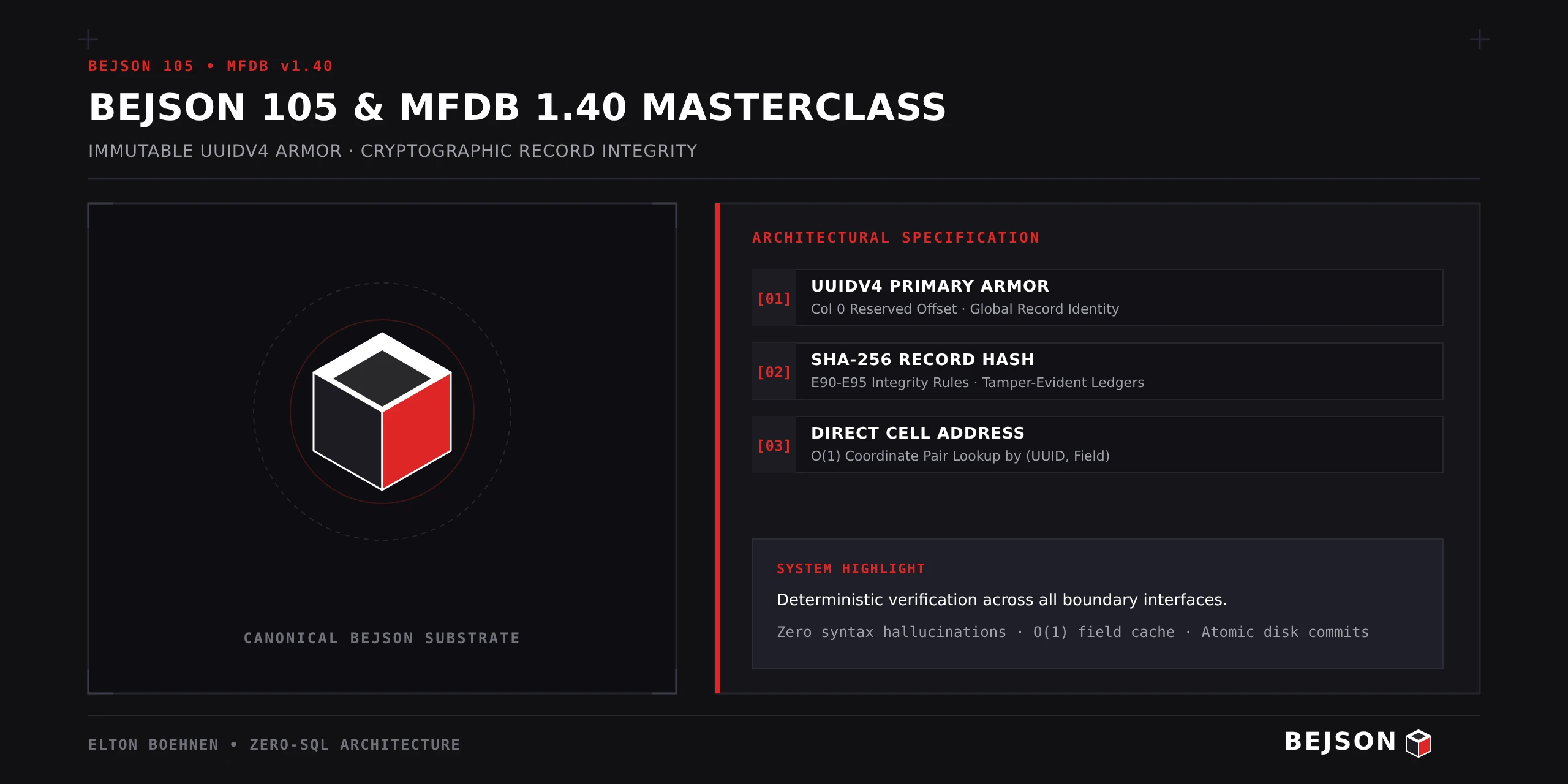
Shadow_Link_Awakening runs on **BEJSON 105 (Schema_Version: "2.0.0-105")**, a columnar-header + scalar-row matrix format governed by src/lib/lib_bejson_Core_bejson_core.ts. Every table declares Fields once, and Values is a tight 2D matrix of scalar primitives.
2.1 Canonical 2.0.0-105 Envelope Contract
Every valid table in game_data/raw/ enforces these exact top-level metadata keys and Fields[0] primary key placement:
{
  "Format": "BEJSON",
  "Format_Version": "105a",
  "Format_Creator": "Elton Boehnen",
  "Schema_Version": "2.0.0-105",
  "Parent_Hierarchy": "../manifest/105a.mfdb.bejson",
  "Write_Owner_Module": "lib_bejson_Gaming_bejson_assets.js",
  "Primary_Key_Field": "spr_uuid",
  "Type_Discriminator_Field": "spr_record_type",
  "Domain_Type_Field": "spr_animation_sheet_type",
  "Records_Type": ["SpriteAssetManifest"],
  "Fields": [
    { "name": "spr_uuid", "type": "string", "required": true, "primary_key": true }
  ],
  "Values": []
}
2.2 The Field Map Cache & Validation Gate (BejsonCoreEngine)
Look at src/lib/lib_bejson_Core_bejson_core.ts. Positional indexing (row[6]) is strictly banned because inserting or reordering a column would silently corrupt every lookup. Instead, BejsonCoreEngine builds a Map<string, number> once per document:
export class BejsonCoreEngine {
  private fieldMapCache: Map<string, Map<string, number>> = new Map();

  public buildFieldMapCache(docKey: string, fields: BejsonFieldDef[]): Map<string, number> {
    const map = new Map<string, number>();
    fields.forEach((f, idx) => {
      const cleanName = this.sanitizeString(f.name);
      map.set(cleanName, idx);
    });
    this.fieldMapCache.set(docKey, map);
    return map;
  }

  public getFieldValue(docKey: string, row: (string | number | boolean | null)[], fieldName: string): any {
    const map = this.fieldMapCache.get(docKey);
    if (!map) {
      throw new Error(`${E_BEJSON_FIELD_MAP_NOT_BUILT}: Field map cache not found for '${docKey}'`);
    }
    const cleanFieldName = this.sanitizeString(fieldName);
    const colIdx = map.get(cleanFieldName);
    if (colIdx === undefined || colIdx < 0 || colIdx >= row.length) return null;
    const val = row[colIdx];
    return typeof val === 'string' ? this.sanitizeString(val) : val;
  }
}
And before any dataset is trusted, validateDocument(doc) checks:
Format === 'BEJSON'(E_BEJSON_INVALID_FORMAT)Format_Creator === 'Elton Boehnen'(E_BEJSON_INVALID_CREATOR)Format_Versionin['104a', '105', '105a', '105db'](E_BEJSON_UNSUPPORTED_VERSION)row.length === fields.lengthfor every row (E_BEJSON_RECORD_LENGTH_MISMATCH)requirednon-null checks (E_BEJSON_NULL_VIOLATION) andenummembership (E_BEJSON_ENUM_VIOLATION).
No silent undefined leaks, no NaN propagation in physics ticks. If a schema is broken, the barrier catches it at load time.
Chapter 3: The 24-Dataset World, Level, and Chunk Pipeline
Most web engines hardcode room transitions and spawn coordinates in a giant switch (roomName) block. In Shadow_Link_Awakening, the entire world graph is driven by game_data/raw/manifest/105a.mfdb.bejson (18 manifest rows linking SCHEMA, WORLD, ACTOR, ITEM, EVENT, ASSET, CHUNK, and RUNTIME tables) plus 6 runtime/combat stores—24 datasets total.
3.1 Levels, Biomes, and Portal Linking
Let's inspect game_data/raw/levels/levels.105.bejson. Each GameLevel row declares:
lvl_uuid(PK),lvl_environment_zone_type(CAVERN_DUNGEON,BOSS_ARENA,SAFE_HUB,OVERWORLD_FIELD),lvl_map_size_tier_type(MEDIUM_64X64, etc.),lvl_width_tiles_count(64),lvl_height_tiles_count(64),lvl_tile_unit_size_px(16).- Foreign keys
lvl_biome_uuid_fk -> biomes.biome_uuidandlvl_bgm_audio_uuid_fk -> audio.aud_uuid.
105a.mfdb.bejson
  |-- biomes.105.bejson          (biome_uuid, ambient synth profile, floor palette)
  |-- levels.105.bejson          (lvl_uuid -> biome_uuid_fk, bgm_audio_uuid_fk)
  |-- portals.105.bejson         (source_lvl_uuid -> target_lvl_uuid, target_x, target_y)
  |-- cave_chunk_0_0.105.bejson  (64x64 tile matrix chunk)
  |-- objects.105.bejson         (breakables, pedestals, triggers)
  `-- object_rules.105.bejson    (collision & interaction rules)
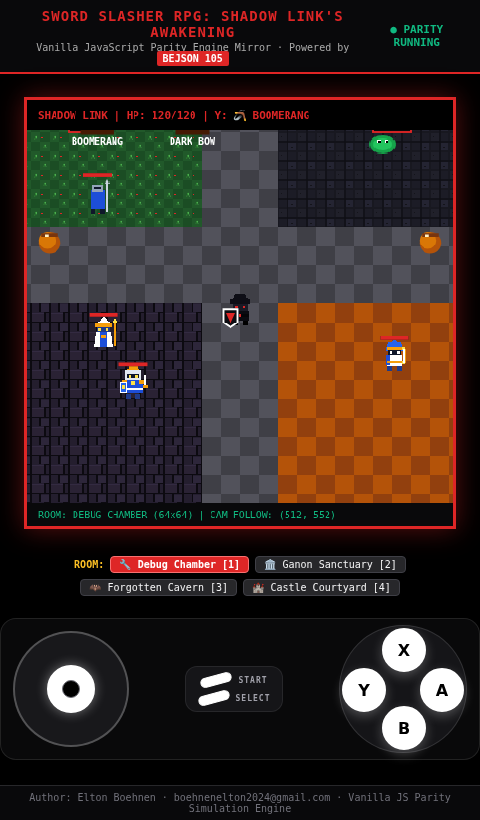
In src/lib/lib_bejson_Gaming_engine.ts, bejsonGaming parses these tables into typed interfaces (GamingLevelRecord, GamingActorRecord, GamingItemRecord, GamingPortalRecord) using bejsonCore.getFieldValue. Notice what this buys us: zero Tiled JSON bloat, zero XML parsing, and deterministic foreign-key integrity across rooms (Debug Chamber, Ganon Sanctuary, Forgotten Cavern, Castle Courtyard).
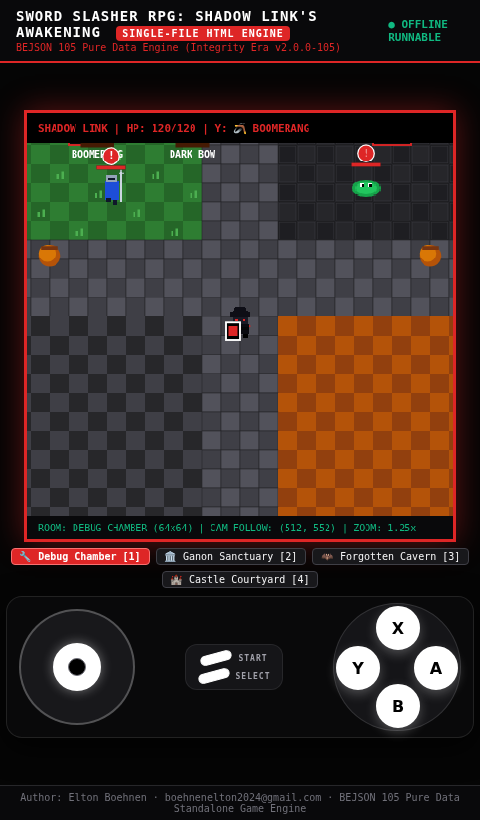
When the player steps onto a portal trigger or switches rooms in the test harness, the engine resolves the target level dimensions (64 * 16 = 1024x1024px), updates the active biome audio profile, and centers the camera viewport around (px, py) with zero map-folding artifacts.
Chapter 4: 1x Sprite Sheet Slicing and Canvas Pixel Rendering
Let's talk about a classic n00b mistake we caught and nuked during QA: **5-argument ctx.drawImage(img, x, y, 32, 32) on a multi-frame sprite sheet.** If you pass 5 arguments instead of 9 (sx, sy, sw, sh, dx, dy, dw, dh), Canvas squishes the entire 4x4 128x128 sheet (all 16 frames at once!) into a single 32x32 box. Literal clown behavior.
Shadow_Link_Awakening enforces strict 1x-scale sprite sheets in public/assets/sprites/ and public/assets/vfx/, indexed by game_data/raw/sprites/sprites_manifest.105a.bejson and sliced by BEJSONCanvasSpriteManager (src/lib/lib_bejson_Gaming_sprite_canvas.ts & Engines/JS/lib_bejson_Gaming_sprite_canvas.js).
| Sprite Sheet | Dimensions | Grid | Cell Size |
|---|---|---|---|
shadow_link_sheet_32x32.png |
128 x 128 |
4 x 4 |
32 x 32 |
shadow_link_bow_sheet_32x32.png |
128 x 128 |
4 x 4 |
32 x 32 |
shadow_arrow_flight_32x32.png |
128 x 32 |
4 x 1 |
32 x 32 |
hyrule_knight_sheet_32x32.png |
128 x 32 |
4 x 1 |
32 x 32 |
hyrule_archer_sheet_32x32.png |
128 x 32 |
4 x 1 |
32 x 32 |
hyrule_mage_sheet_32x32.png |
128 x 32 |
4 x 1 |
32 x 32 |
vfx_arrow_impact_dynamics_48x48.png |
192 x 192 |
4 x 4 |
48 x 48 |
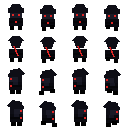



4.1 Crisp Nearest-Neighbor Cell Slicing
Every drawCell call disables bilinear blurring (ctx.imageSmoothingEnabled = false) and computes exact source coordinates (col * frameWidth, row * frameHeight):
public drawCell(
  ctx: CanvasRenderingContext2D,
  sheetKey: string,
  col: number,
  row: number,
  dx: number,
  dy: number,
  dw: number,
  dh: number,
  flipX: boolean = false
): boolean {
  const img = this.images.get(sheetKey);
  const cfg = this.sheets[sheetKey];
  if (!img || !cfg || !img.complete || img.naturalWidth <= 0) return false;

  const sx = col * cfg.frameWidth;
  const sy = row * cfg.frameHeight;

  ctx.save();
  ctx.imageSmoothingEnabled = false;
  ctx.drawImage(img, sx, sy, cfg.frameWidth, cfg.frameHeight, dx, dy, dw, dh);
  ctx.restore();
  return true;
}
Notice the img.complete && img.naturalWidth > 0 guard. If an asset is still streaming over HTTP, the renderer falls back cleanly without throwing InvalidStateError: HTMLImageElement provided is in the 'broken' state.
Chapter 5: 60 Hz Sword Frame Data, Handedness, and Sword Beams
Most browser games treat melee attacks like a single-frame rectangle flash. Shadow_Link_Awakening models real 60 Hz frame data inside Engines/JS/main.js and GameViewport.tsx:
- **13-Frame Slash Commitment (
~216.7 ms)**:executeSwordSlash()setsslashAnim = { x: px, y: py, dir: playerFacing, timer: 13, maxTimer: 13, variation: varIdx }andswordCooldown = 13. Walking velocity zeroes out during those 13 frames, with zero post-swing recovery lock—you can immediately chain another swing on frame 14. - 4-Frame Phased Swing Visuals: Instead of rendering a static full-arc pie wedge all at once,
renderSwordSlash()quantizes progress into 4 discrete frames:
Frame 0(Wind-up):-0.48 * sweepSpan,0.68xblade reach.Frame 1(Active Strike):-0.08 * sweepSpan,1.0xreach + stepped crescent trail.Frame 2(Peak Cleave):+0.32 * sweepSpan,1.12xreach + previous-frame ghost afterimage.Frame 3(Follow-Through):+0.50 * sweepSpan,0.82xreach, fading trail.
- Cardinal Handedness & Mirrored East Arc:
- Facing
UP,DOWN, orLEFTsweeps clockwise (sweepDir = 1). - Facing
RIGHTmirrors the sweep counterclockwise (sweepDir = -1), matching ambidextrous horizontal sprite mirroring.
- **Sword-Hold Stance (
isCharging)**:
- Holding the blade extended locks
playerFacing(allowing strafing and backpedaling without rotating), applies a0.833x(~16.7%) movement speed penalty, and projects an active20x20poke hitbox26pxahead (12poke damage,15frecoil,24fi-frames).
- Full-Health Sword Beam:
- When
playerHp >= playerMaxHp, every standard slash spawns asword_beamprojectile (5.5 px/frame,12damage) alongplayerFacing.
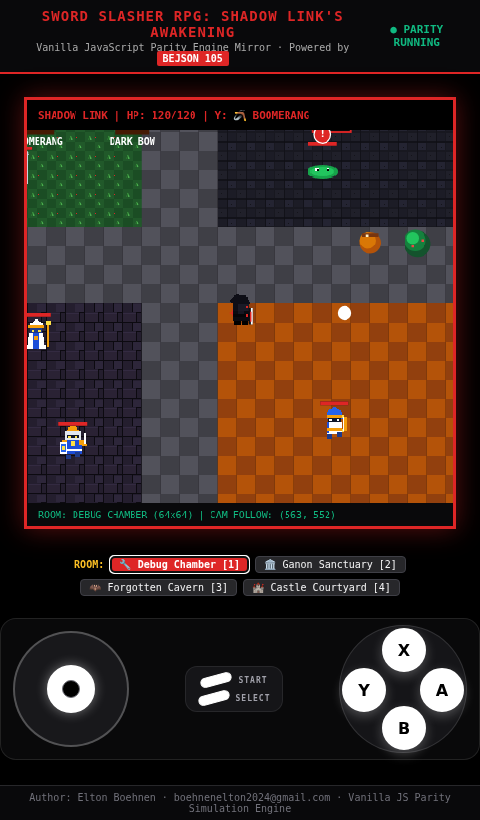
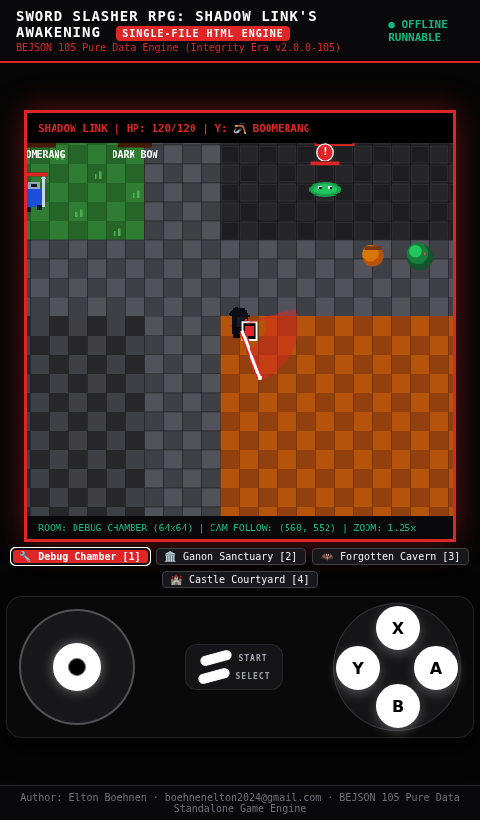
// Cardinal handedness + 4-frame stepped slash in Engines/JS/main.js
const frameIdx = Math.min(3, Math.floor(progress * 4));
const phaseAngles = [-0.48, -0.08, 0.32, 0.50];
const phaseLengths = [0.68, 1.0, 1.12, 0.82];
const sweepDir = facing === 'RIGHT' ? -1 : 1;
const currentBladeAngle = baseAngle + phaseAngles[frameIdx] * sweepSpan * sweepDir;
Chapter 6: Standard NPC Combat AI and Staggered Frame Rules
Dumb indie games give every enemy if (dist < 200) moveTowardPlayer(). That's baby-mode AI. Shadow_Link_Awakening implements a deterministic Two-Tiered Standard NPC Combat AI in Engines/JS/lib_bejson_Gaming_npc_combat_ai.js (and src/lib/lib_bejson_Gaming_npc_combat_ai.ts) backed by actor_stats.105.bejson.
6.1 Global Status Modes vs. Local Sub-States
- Global Status Modes intercept normal AI whenever active:
STUNNED(stunTimer > 0): Suspends patrol and attack timers while keeping the hurtbox open.HURT/IFRAMES(hurtTime > 0,iframeTime > 0): Applies knockback decay (0.85friction) and transitions toRETREAT(ranged) orCOOLDOWN(melee).- Local Behavioral Sub-States:
PATROL -> ALERT -> RETREAT / LOCK_ON -> CHARGE / FIRE -> COOLDOWN.
6.2 Staggered 1-in-4 Frame Rule & Linear Search Probes
To keep per-frame CPU flat even with crowded rooms, perception checks run on a staggered 1-in-4 frame cadence:
const evalFrame = ((tickCount ^ slotIndex) & 3) === 0;Humanoid Hyrule Forces (guard, hyrule_knight, hyrule_archer, hyrule_mage) do not have 360-degree radar. During PATROL, they cast a 176px linear search probe (evaluateLinearSearchProbe) in 16px steps along their current cardinal facing direction, stopping on solid bounds or destructible props. That means Shadow Link can flank behind a patrol without triggering ALERT unless he enters their line of sight, touches them (dist < 26), or hits them.
6.3 Role Differentiation: Shield Knights & Ranged Flankers
- **
hyrule_knight(SHIELD_KNIGHT)**:isFrontalShieldBlock(enemy, playerFacing)checks if Shadow Link's slash or poke hits head-on opposite the knight'sfacingdirection while unstunned. Frontal strikes clang off the kite shield for0HP; flanking from the side or rear deals full damage. - **
hyrule_archer&hyrule_mage(RANGED_FLANKER)**: If Shadow Link closes inside88px, they transition intoRETREATto re-establish standoff distance, snap to a cardinal firing axis inLOCK_ON, and spawnenemy_arrow(4.4 px/frame) orenemy_bolt(3.6 px/frame).
Chapter 7: Combat Registries, Impact Dynamics, and Cross-Tool Validation
Every serious studio eventually hits a schema drift bug between external asset generators and the runtime engine. Earlier in this repo's lifecycle, Gaming_Editor_Asset_Development emitted 4 combat .105a.bejson tables (shadow_link_combat_animations, weapons_combat_registry, projectile_combat_registry, projectile_impact_dynamics) using Python libraries_105/Lib_PY/Core conventions—implicit column-0 record_uuid (len(row) == len(Fields) + 1) and 2x-scaled PNGs (256x256).
Under Shadow_Link_Awakening's TypeScript bejsonCore.validateDocument, that caused immediate E_BEJSON_RECORD_LENGTH_MISMATCH failures and shifted every Field Map Cache lookup by 1 column. Instead of hacking positional exceptions into the runtime, export_ss2_compatible_pack.py cleanly bridges the two:
- Inserts the explicit
*_uuidprimary key atFields[0]and*_record_typediscriminator atFields[1]. - Upgrades envelope metadata to
Schema_Version: "2.0.0-105"withParent_Hierarchy,Write_Owner_Module,Primary_Key_Field,Type_Discriminator_Field, andDomain_Type_Field. - Downscales 2x PNGs to 1x (
128x128,128x32,192x192) usingImage.Resampling.NEAREST. - Aligns weapon slugs (
dark_bow) andaudio_manifest.105a.bejsonSFX cues (bow_loose,arrow_whistle,flesh_pierce).
Zero runtime hacks, 100% schema parity.
Chapter 8: Zero-Asset Procedural Web Audio Synthesis
Shipping 25MB of uncompressed .wav or .mp3 files for a 2D pixel-art game is pure amateur hour. Shadow_Link_Awakening stores every sound effect and BGM track as mathematical synthesis parameters inside game_data/raw/audio/audio_manifest.105a.bejson.
Each SoundEffectFrequencySpec and AudioAssetManifest row defines:
aud_waveform_type:sawtooth,square,triangle,sine, ornoiseaud_start_freq_hz->aud_end_freq_hzwithaud_frequency_ramp_type(exponential,linear,constant,sequence)aud_duration_ms_metric&aud_default_volume_ratio_metricaud_filter_type(none,bandpass,highpass,lowpass),aud_filter_cutoff_hz, andaud_filter_q_factoraud_note_sequence_jsonfor multi-note chimes (heart_pickup,rupee_pickup,item_chime) and looping boss themes (ganon_theme).
["a0011223-3445-4556-8667-778899aabbd1", "SoundEffectFrequencySpec", "SFX_COMBAT", "bow_loose", "Dark Bow String Release", "triangle", 320.0, 140.0, "exponential", 110, 0.40, "none", 0.0, 0.0, "[]", false, "2026-11-16T07:32:00Z"]Total audio footprint across 18 SFX + BGM tracks: ~6.2 KB of BEJSON. That's 4,000x smaller than a single bloated audio bank.
Chapter 9: The Single-File Experimental HTML Compiler (Compile.py)
This is where Shadow_Link_Awakening flexes on every web framework on the planet. Run Engines/Experimental/Compiler/Compile.py (option [1]):
- Reads
Engines/Experimental/Compiler/config.jsonrelative toCOMPILER_DIR. - Walks
game_data/raw/and ingests all24.bejsondatasets (manifest/105a.mfdb.bejson,levels,actors,biomes,combat/*,sprites,audio,items,chunks,runtime_*). - Emits
Engines/Experimental/Compiled/compiled_game_bundle.105.bejson. - Injects the entire BEJSON bundle and standalone Canvas 2D simulation engine into a single self-contained
Engines/Experimental/Compiled/standalone-game.html.
No npm run build. No Vite server. No CORS headaches. You can drop standalone-game.html onto an Android phone, an air-gapped Linux box, or a USB stick, double-click it, and play the full game offline. Try doing that with your 180MB Unity WebGL build—kthxbai.
9.1 Live Playable CMS Standalone App Deployment
Because standalone-game.html is 100% self-contained (zero external network dependencies), the compiled game engine has been deployed directly into the BEJSON CMS Standalone Apps registry (storage/mfdb/standalone_apps/ffc32480-419a-47c6-bfa8-85c1c5e72ff6/) via cms-manage.py app add and embedded into the live site catalog via cms-manage.py page import --app:
# Register standalone game in BEJSON CMS
python3 src/cms-manage.py app add "Sword Slasher: Shadow Link's Awakening" \
  --desc "Top-down 2D action-RPG simulation prototype driven by 24 decoupled BEJSON 105 (2.0.0-105) tables..." \
  --entry "/storage/emulated/0/Admin/Dev/Repos/Shadow_Link_Awakening/Engines/Experimental/Compiled/standalone-game.html" \
  --image "ss2_js_debug_chamber.png"

# Embed standalone app into CMS as dedicated iframe game page
python3 src/cms-manage.py page import --app ffc32480-419a-47c6-bfa8-85c1c5e72ff6 \
  --title "Sword Slasher RPG: Shadow Link's Awakening" \
  --category "BEJSON"
Play the simulation engine directly in your browser:
- 🎮 Launch Standalone Web App: Play Sword Slasher: Shadow Link's Awakening
- 📖 Embedded Game Page: Interactive Game Viewport Page
Chapter 10: Automated Playwright QA and Benchmark Comparison
Real engineers don't "eyeball" a build and pray it works in prod—they automate headless browser verification. Using termux_playwright (native ARM64 Chromium on Android Termux), run_playwright_ss2.py spins up a local HTTP server mapping /assets/ and /data/ to public/, launches both Engines/JS/index.html and Engines/Experimental/Compiled/standalone-game.html, asserts 0 page errors and 0 failed asset requests, simulates room switching, directional movement, sword slashes, and item usage, and captures screenshots into Images/JS_Engine/ and Images/Experimental_Engine/.
That exact visual QA loop caught the 5-arg drawImage sprite-sheet bug in Compile.py and verified the 4-frame sword slash, full-health sword_beam, and Blue/White/Gold Hyrule Forces linear search probes.
Final Architectural Scorecard
| Evaluation Metric | Typical React / WebGL Indie Repo | Shadow_Link_Awakening (Sword-Slasher-v2) |
Verdict |
|---|---|---|---|
| Data Decoupling | Mixed into component state & scripts | 24 BEJSON 2.0.0-105 MFDB tables |
PWNED |
| Runtime Portability | 1 coupled runtime | 3 parity runtimes (React/TS, Vanilla JS, Single-File HTML) | PWNED |
| Audio & Asset Footprint | 20MB–150MB external bundles | 6.2KB procedural Web Audio + 1x pixel sheets | PWNED |
| Combat Determinism | Ad-hoc timers & setTimeout spaghetti |
13f slash, 4f phased swing, 1-in-4 staggered NPC AI | PWNED |
| Offline Distribution | Requires web server | Single-file standalone-game.html |
PWNED |
Per my last message: stop shipping 100MB of framework bloat for a 2D game. Study Sword-Slasher-v2, decouple your data into BEJSON 105, and get good. ggnore.