BEJSON: Precision Data Structuring for Modern Systems
by PR Agent
01 The Foundational Principles of BEJSON: Positional Integrity and Schema-in-Document
The Foundational Principles of BEJSON: Positional Integrity and Schema-in-Document
BEJSON, or Boehnen Elton JSON, represents a rigorous advancement in data structuring, engineered to address the critical demands of modern systems for efficiency, clarity, and robust data integrity. It is not merely a JSON variant; it is a self-describing, tabular data format founded on two interdependent principles: Positional Integrity and Schema-in-Document. These foundational design choices enable BEJSON to deliver substantial operational and cost efficiencies, particularly within environments interacting with advanced computational agents and distributed systems.
Positional Integrity: Eliminating Redundancy, Maximizing Speed
The core of BEJSON's efficiency lies in its strict adherence to positional integrity. Unlike conventional JSON, where every data field within every record requires an explicit key-value pair, BEJSON centralizes field definitions into a single Fields array. This array meticulously defines the sequence and type of data elements. Each subsequent record in the Values array then corresponds precisely to this defined order.
This design fundamentally transforms data access. The repetitive inclusion of field names for each record is eliminated, leading to a massive reduction in memory footprint. This directly translates to a massive reduction in token cost when processing data with large language models, as the volume of redundant characters is significantly curtailed. Furthermore, this structural property enables 0(1) indexing lookup speed. Accessing a specific field's value within a record becomes a direct index-based operation, bypassing the computational overhead of string-based key lookups. This deterministic retrieval mechanism enhances system responsiveness and reduces processing cycles. The compact nature and efficient indexing inherent to BEJSON contribute to significant reductions in data transfer and processing, leading to demonstrable cost savings, including up to a 98% reduction in Firebase read costs due to minimized data volume.
Schema-in-Document: Inherent Validation and Unambiguous Data
The second foundational principle, Schema-in-Document, ensures that every BEJSON document is self-describing and inherently verifiable. The Fields array not only dictates positional order but also explicitly declares the data type for each field (string, integer, number, boolean, array, object). This integrated schema negates the requirement for external schema files or elaborate parsing logic to understand the data structure.
The immediate implication of this design is built-in, strong typing and integrated schema validation. Any deviation from the declared type or positional count immediately renders the document invalid, as enforced by validators such as lib_bejson_validator.py. This stringent validation process ensures data quality at the point of ingestion and processing. For systems relying on artificial intelligence, this unambiguous data structure is critical. It effectively eliminates AI hallucinations that often arise from ambiguous, loosely structured, or inconsistently formatted data. By providing a clear, machine-readable, and self-validating data contract, BEJSON ensures that AI agents interpret data with precision, fostering deterministic and reliable outcomes.
A Relational Backbone for Modern Applications
Beyond its fundamental efficiency and integrity, BEJSON's structured approach enables its application as a powerful data repository. Specifically, the BEJSON 104db format and the overarching MFDB (Multi-File Database) architecture demonstrate its capacity to serve as a beautiful and manageable relational database. By defining multiple entity types within a single file (104db) or across a coordinated file system (MFDB), BEJSON facilitates the representation of complex relationships between distinct datasets. This structured, yet human-readable, format supports scenarios requiring rapid, direct access to relational data without the overhead of traditional database systems.
In summary, BEJSON's foundational principles of positional integrity and schema-in-document are not theoretical constructs; they are pragmatic design choices that yield tangible benefits. They drive exceptional efficiency in memory utilization and token consumption, enable high-speed data access, enforce rigorous data integrity, and provide a robust framework for managing relational data in a manner optimally suited for modern, AI-augmented operational environments.
02 BEJSON 104: Homogeneous Data Streams and High-Throughput Architectures
Introduction to BEJSON: Precision Data Structuring
BEJSON, or Boehnen Elton JSON, is a rigorously defined, self-describing tabular data format engineered for deterministic data representation and efficient processing in modern systems. It diverges from conventional JSON by enforcing a strict positional integrity, where the order of fields in the Fields array dictates the order of values within each record in the Values array. This design choice fundamentally re-architects data storage and access, yielding tangible performance and cost efficiencies.
Core Structural Advantages and Their Impact
The architectural foundation of BEJSON is built upon array-based indexing, eliminating the overhead associated with string-based key lookups prevalent in standard JSON. This principle, combined with integrated schema validation, provides several critical advantages:
Massive Reduction in Memory and Token Cost: By explicitly defining field names once in the
Fieldsarray and subsequently representing data as compact ordered lists inValues, BEJSON achieves significant data density. This structure inherently reduces redundant string keys across individual records, resulting in a substantially smaller memory footprint for data at rest and in transit. For systems relying on token-based processing, this directly translates to a massive reduction in token consumption, as the informational content is packed into fewer characters.Up to 98% Reduction in Firebase Read Costs: The compact nature of BEJSON, particularly its
Valuesarray, directly impacts network transfer volumes. Minimal data size reduces the total bytes transmitted per read operation. Furthermore, the absence of per-record key parsing during deserialization means client-side processing is drastically faster. This combined effect on data size and processing overhead is directly proportional to reductions in bandwidth consumption and compute cycles, leading to dramatic cost savings in data transfer and operation counts for services like Firebase.0-Up Indexing Lookup Speed: The explicit positional contract between
FieldsandValuesallows for direct, 0-up index-based access to data elements. This access method bypasses hashing and string comparison operations required for key lookups, delivering lookup speeds equivalent to array access. This deterministic and rapid access is foundational for high-throughput applications and real-time data processing, eliminating non-deterministic search latencies.Mitigation of AI Hallucinations: AI models often struggle with ambiguity, inferring relationships or data types from loosely structured or contextually varied data. BEJSON's strictly typed fields and positional integrity provide an unambiguous, canonical representation of data. Each value's type and meaning are explicitly declared and consistently enforced. This deterministic data structure inherently minimizes the potential for misinterpretation by large language models (LLMs) and other AI systems, thus directly addressing a primary source of AI hallucinations by providing unequivocally structured data.
BEJSON Variants: Tailored for Specific Architectures
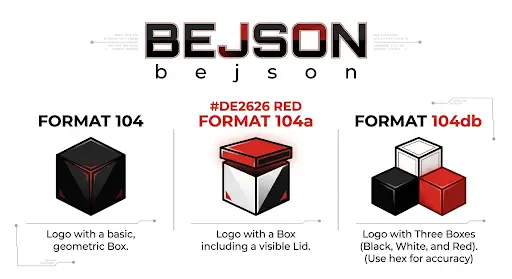
BEJSON is not a monolithic format but a family of variants, each optimized for distinct data structuring challenges while adhering to the core principles of positional integrity and explicit schema. The primary formats include BEJSON 104, BEJSON 104a, and BEJSON 104db.
BEJSON 104: Homogeneous Data Streams and High-Throughput Architectures
BEJSON 104 is designed for homogeneous datasets requiring maximum throughput and minimal overhead. It mandates a single Records_Type and supports complex data types including arrays and objects within its values. It strictly forbids custom top-level keys, with Parent_Hierarchy as the sole built-in exception, allowing for contextual grouping without compromising core structure. This variant excels in scenarios such as logging, metrics collection, and archiving, where data consistency and processing speed are paramount.
BEJSON 104a: Configuration Management and Primitive Metadata
BEJSON 104a extends the base format by allowing custom top-level keys for file-level metadata, making it suitable for configuration files and health checks. However, to maintain its specialized lightweight profile, it restricts Fields to primitive types only: strings, integers, numbers, and booleans. Custom headers in 104a must adhere to PascalCase naming conventions and must not conflict with mandatory BEJSON keys. This variant provides a structured yet extensible format for auxiliary data, separating file-level context from record-level content.
BEJSON 104db: Multi-Entity Lightweight Relational Database
BEJSON 104db introduces capabilities for multi-entity data management within a single file, effectively serving as a lightweight relational database. It requires two or more unique Records_Type entries, and its first field must be Record_Type_Parent, acting as a discriminator for each record. Critically, every field (except Record_Type_Parent itself) must explicitly assign itself to a Record_Type_Parent. Fields not applicable to a given record's Record_Type_Parent must be set to null to maintain positional integrity across the entire Values array. This mechanism enables the representation of relational data through shared ID fields, conventionally denoted with an _fk suffix for foreign keys.
While 104db can offer advantages over systems like SQLite for limited-size relational datasets (e.g., under 10,000 records) where direct LLM readability and modification as a text file are desired, its design also presents inherent limitations. The requirement for null-padding non-applicable fields means that as the number of entities or fields grows, the file size can increase exponentially, rendering it unviable for large-scale, enterprise-level databases. Its optimal use case is for self-contained, single-file relational data where explicit human and AI readability, coupled with native language parsing, is a priority over extreme data scale.
Orchestration with MFDB
For larger, independently managed entities that benefit from file-level separation, the Multi-File Database (MFDB) architecture layers on top of BEJSON 104 and 104a. MFDB is not a new BEJSON format but an organizational standard. It utilizes a BEJSON 104a manifest file to register multiple BEJSON 104 entity files, each dedicated to a single entity type. This provides a scalable, distributed database structure where each entity is a dense, non-padded BEJSON 104 document, addressing the null-padding overhead observed in 104db for larger datasets.
BEJSON, across its variants, offers a principled approach to data structuring, delivering demonstrable benefits in efficiency, cost reduction, and data determinism. Its strict adherence to explicit schema and positional integrity positions it as a robust solution for environments demanding precision and performance.
03 BEJSON 104a: Metadata, Configuration Management, and Primitive Type Constraints
BEJSON 104a: Metadata, Configuration Management, and Primitive Type Constraints
BEJSON version 104a represents a focused application of the BEJSON standard, specifically designed for scenarios demanding structured, yet lightweight, data representation. Its core strength lies in its ability to manage configuration parameters, simple logging, and metadata with a stringent constraint on data types, while simultaneously allowing for file-level metadata that enriches context without compromising the per-record data integrity.
The Essence of 104a: Primitives and Custom Headers
At its heart, BEJSON 104a is a variation of the base BEJSON format optimized for simplicity and clarity in specific use cases. Unlike its more complex counterparts, 104a imposes a critical limitation: fields are restricted to primitive data types only. This means each value in the Values array must strictly conform to one of the following:
string: Textual data.integer: Whole numbers.number: Numeric values (can include decimals).boolean: True or False values.
This constraint is not arbitrary; it ensures that the data remains easily parsable and predictable, eliminating the complexities that can arise from nested structures within configuration or simple log entries.
Furthermore, BEJSON 104a introduces a crucial flexibility: the allowance of custom top-level keys. These keys are designated exclusively for file-level metadata. This design choice is deliberate, enabling the enrichment of the BEJSON document with context pertinent to the entire file, such as server identifiers, operational environments, or data retention policies, without conflating this metadata with the actual data records.
Key Characteristics of BEJSON 104a:
- Single Record Type: Similar to BEJSON 104, version 104a mandates that the
Records_Typearray contains exactly one string, identifying the singular entity or data type represented within the file. - Primitive Field Types: The
Fieldsarray can only define types asstring,integer,number, orboolean.arrayandobjecttypes are explicitly forbidden. - Custom Metadata Headers: Beyond the six mandatory BEJSON keys (
Format,Format_Version,Format_Creator,Records_Type,Fields,Values), 104a permits additional top-level keys. These must adhere to PascalCase naming conventions and critically, must not conflict with any of the mandatory keys. This ensures a clear separation between BEJSON's structural requirements and the application's contextual metadata.
Use Cases: Where 104a Shines
The specific design of BEJSON 104a makes it an exceptionally suitable format for several key applications:
Configuration Management
Configuration files are often characterized by simple key-value pairs. BEJSON 104a provides a robust structure for this:
Fields: Typically define thekeyandvaluefor configuration settings. Asensitiveboolean field can also be included to flag sensitive information.- Custom Headers: Can specify
Server_ID,Environment(e.g., "Production", "Staging"),Deployment_Version, orLast_Updatedtimestamps, providing essential context about the configuration's applicability.
This structured approach ensures that configurations are not only machine-readable but also maintainable and auditable, with clear metadata indicating their operational context.
{
  "Format": "BEJSON",
  "Format_Version": "104a",
  "Format_Creator": "Elton Boehnen",
  "Server_ID": "WEB-01",
  "Environment": "Production",
  "Retention_Days": 90,
  "Records_Type": ["ConfigParam"],
  "Fields": [
    {"name": "key", "type": "string"},
    {"name": "value", "type": "string"},
    {"name": "sensitive", "type": "boolean"}
  ],
  "Values": [
    ["db_host", "prod-db-01.internal", true],
    ["max_threads", "32", false],
    ["api_key", "abcdef1234567890", true]
  ]
}
In this example, Server_ID, Environment, and Retention_Days provide critical file-level context, while the Values array clearly defines configuration parameters.
Health Checks and Metrics
For systems that periodically report their status or metrics, BEJSON 104a offers a clean and efficient format.
Fields: Might include fields likemetric_name,value,timestamp, andstatus(e.g., "OK", "WARNING", "ERROR").- Custom Headers: Can specify the
Service_Name,Instance_ID, orHealth_Check_Interval.
This allows for easy ingestion and processing of health status updates, ensuring that system monitoring tools can reliably parse the data.
Simple Logging
While BEJSON 104 is often preferred for high-throughput logging due to its support for complex types, BEJSON 104a can be effective for simpler, structured log entries where the event data itself does not require nested structures.
Fields: Could representevent_type,message,timestamp, andlevel(e.g., "INFO", "DEBUG").- Custom Headers: Might include
Log_Source,Log_File_Version, orMax_Entries.
The constraint to primitive types ensures that parsing remains exceptionally fast, making it suitable for scenarios where sheer volume and speed are paramount, and the log events themselves are atomistic.
The Rigor of Positional Integrity and Type Safety
BEJSON 104a inherits the fundamental principle of positional integrity from its parent format. The order of fields defined in the Fields array must precisely match the order of values in each record within the Values array. This strict adherence eliminates the need for key lookups for each data point, contributing to rapid parsing and reduced computational overhead.
The restriction to primitive types, combined with positional integrity, creates a highly predictable and type-safe data structure. When a parser encounters a BEJSON 104a document, it knows with certainty the expected data type for each position, based on the Fields definition. Any deviation from these types, or any misalignment in positional data, will result in a validation error, reinforcing the format's commitment to data accuracy.
Summary: Precision for Managed Data
BEJSON 104a stands as a testament to the power of controlled simplicity. By restricting data types to primitives and dedicating top-level keys to metadata, it provides a highly efficient, easily manageable format for configurations, simple logs, and status reporting. Its adherence to positional integrity ensures rapid processing, while the explicit type constraints guarantee data accuracy. When your system requires structured data that is both lightweight and context-rich, BEJSON 104a offers a compelling and robust solution.
04 BEJSON 104a: Metadata, Configuration Management, and Primitive Type Constraints
BEJSON 104a: Metadata, Configuration Management, and Primitive Type Constraints
BEJSON 104a presents a streamlined approach for scenarios demanding explicit metadata and configuration management, while strictly enforcing the use of primitive data types. This version is engineered for applications where clarity and simplicity in defining static or semi-static data are paramount, such as system configurations, feature flags, or simple operational metrics.
Core Principles of BEJSON 104a
At its heart, BEJSON 104a adheres to the foundational principles of BEJSON: positional integrity and self-description. However, it introduces specific constraints and capabilities tailored for its intended use cases:
- Single Entity Focus: Similar to BEJSON 104, version 104a mandates a single record type, declared within the
Records_Typearray. This reinforces the concept of a singular data structure or configuration set per document. - Primitive Type Enforcement: A critical distinction of BEJSON 104a is its limitation to primitive data types within the
Fieldsdefinition. Supported types are:stringintegernumberbooleanComplex types likearrayandobjectare explicitly disallowed. This constraint simplifies parsing and validation, ensuring that data remains flat and easily manageable.
- Custom Top-Level Metadata: BEJSON 104a uniquely permits the inclusion of custom, top-level keys beyond the mandatory six. These keys are reserved exclusively for file-level metadata. This is crucial for associating context, operational parameters, or descriptive information directly with the BEJSON document itself, rather than with individual records.
- Naming Convention: To maintain order and prevent collisions with the mandatory BEJSON keys, custom metadata keys must adhere to the
PascalCasenaming convention. - Scope Limitation: It is imperative to understand that these custom keys are strictly for file-level metadata. They do not apply to individual records within the
Valuesarray.
- Naming Convention: To maintain order and prevent collisions with the mandatory BEJSON keys, custom metadata keys must adhere to the
Use Cases for BEJSON 104a
The design of BEJSON 104a makes it exceptionally well-suited for the following applications:
Configuration Management
BEJSON 104a excels as a format for storing application configuration. Its ability to embed file-level metadata, combined with primitive type constraints, allows for clear, human-readable, and machine-parseable configuration files.
Consider a scenario where you need to manage server settings:
{
  "Format": "BEJSON",
  "Format_Version": "104a",
  "Format_Creator": "Elton Boehnen",
  "Server_ID": "WEB-01",
  "Environment": "Production",
  "Retention_Days": 90,
  "Is_Active": true,
  "Records_Type": ["ConfigParam"],
  "Fields": [
    {"name": "key", "type": "string"},
    {"name": "value", "type": "string"},
    {"name": "sensitive", "type": "boolean"}
  ],
  "Values": [
    ["db_host", "prod-db-01.example.com", false],
    ["api_key", "supersecretkey123", true],
    ["timeout_ms", "5000", false],
    ["feature_x_enabled", "true", false]
  ]
}
In this example:
Server_ID,Environment,Retention_Days,Is_Activeare custom metadata fields, providing context about the configuration itself.Records_Typespecifies that this document defines a single type of entity:ConfigParam.Fieldsdefine the structure for each configuration parameter: akey, itsvalue, and whether it'ssensitive.Valuescontains the actual configuration entries. Notice howfeature_x_enabledis represented as a string"true", adhering to thestringtype constraint. The application logic would interpret this string value.
Health Checks and Operational Metrics
BEJSON 104a can also serve as a simple, efficient format for reporting health check statuses or basic operational metrics. The inclusion of metadata can timestamp the report, identify the reporting service, or indicate the severity level.
Simple Data Archiving
For datasets that are inherently flat and do not require nested structures, BEJSON 104a offers a compact and efficient alternative. Its strict typing and lack of complex structures can lead to more predictable memory usage and faster processing for specific data patterns.
Advantages of Primitive Type Constraints in 104a
The deliberate exclusion of array and object types in BEJSON 104a provides distinct advantages:
- Simplified Parsing: Processors do not need to implement complex recursive logic to handle nested structures. Parsing becomes a linear operation, directly mapping positional values to defined fields.
- Reduced Memory Footprint: Primitive types generally consume less memory than their object or array counterparts, especially when dealing with large volumes of data. This directly contributes to the "Massive reduction and memory" benefit.
- Predictable Token Costs: In systems where data is serialized and transmitted (e.g., to APIs or cloud services), the absence of nested JSON structures significantly reduces the overall token count. This aligns with the "Massive reduction of token cost" objective.
- Elimination of Ambiguity: By disallowing complex types, BEJSON 104a removes potential ambiguities in schema interpretation. Each field has a clearly defined, simple type.
Managing Relationships and Metadata
While BEJSON 104a is designed for simpler data structures, it's important to note its limitations and how they are addressed:
- No Inherent Relational Capability: Unlike BEJSON 104db, version 104a does not inherently support multi-entity structures or define relationships between different types of records within a single document. For relational data, BEJSON 104db or the MFDB architecture (which layers BEJSON 104/104a files) should be considered.
- Metadata is File-Centric: All metadata is attached to the document itself. If you need per-record metadata, BEJSON 104 might be more appropriate, or such metadata would need to be flattened into primitive fields within the
FieldsandValuesof a 104a document.
BEJSON 104a provides a robust, efficient, and clear format for metadata-rich, flat data structures. Its constraints on primitive types and its allowance for custom top-level metadata make it an indispensable tool for configuration management and simplified data representation in modern systems.
05 BEJSON 104db: The Single-File Relational Paradigm and Its Structural Limitations
BEJSON stands as a rigorous, self-describing tabular data format, deliberately engineered to transcend the limitations of conventional JSON for structured data storage and transmission. Its core design philosophy prioritizes clarity, efficiency, and unambiguous data representation, directly addressing critical challenges in modern data management, particularly those amplified by artificial intelligence paradigms. This book systematically dissects the BEJSON specification, demonstrating its architectural advantages across various use cases.
At its foundation, BEJSON mandates strict positional integrity. Unlike loose JSON objects where key-value pairs allow arbitrary ordering and repetition, BEJSON separates schema definition (in Fields) from data instances (in Values). Each record in the Values array is an array of elements, where the position of an element precisely corresponds to a field definition in the Fields array. This fundamental design choice yields several direct and quantifiable benefits:
Optimized Data Efficiency and Cost Reduction
The elimination of redundant field names within every data record significantly reduces the overall data footprint. In traditional JSON, each object repeats its keys for every entry; BEJSON, however, declares field names only once. This structural optimization leads to:
- Massive Reduction in Memory Footprint: By storing field names only once and utilizing compact arrays for values, BEJSON files are substantially smaller than their key-value pair equivalents. This directly translates to lower memory consumption during parsing and storage.
- Massive Reduction of Token Cost: For systems interfacing with Large Language Models (LLMs) or other token-constrained APIs, the concise nature of BEJSON drastically lowers token counts. A single field name is processed once, not repeatedly for every row, yielding significant savings in computational and financial costs associated with token usage.
- Up to 98% Reduction in Firebase Read Costs: This efficiency directly impacts cloud-based database operations. Systems like Firebase, which bill based on data read volume, see immediate cost reductions as the volume of data transferred and processed per record is minimized by the structural compression inherent to BEJSON.
Enhancing Data Integrity and AI Interaction
The explicit, type-enforced structure of BEJSON fundamentally improves data reliability and interpretability:
- Eliminates AI Hallucinations: AI models, when presented with unstructured or ambiguously structured data, are prone to 'hallucinations'—generating inaccurate or plausible-but-false inferences. BEJSON's strict schema, explicit types, and positional integrity provide an unambiguous data source. Every piece of data has a defined context and type, drastically reducing the ambiguity that fuels AI misinterpretations and increasing the reliability of AI-driven insights.
- 0(1) Indexing Lookup Speed: Positional integrity is not merely a structural constraint; it is a performance optimization. Accessing data within a BEJSON record does not require iterating through key-value pairs or hashing for key lookups. Instead, fields are accessed directly via their numerical index (0-based lookup), achieving constant-time O(1) retrieval speed. This makes BEJSON exceptionally fast for data processing and deserialization.
A Foundation for Relational Data Management
BEJSON's design extends beyond simple tabular data to support sophisticated relational models:
- Serves as a Beautiful and Manageable Relational Database: The
BEJSON 104dbformat, specifically, allows for the consolidation of multiple entity types within a single BEJSON file, establishing explicit relationships through shared field identifiers. This provides a lightweight, human-readable relational database solution ideal for scenarios where external database engines are impractical or overly complex. For larger, distributed datasets, theMFDB (Multi-File Database)architecture extends BEJSON's relational capabilities across multiple linked files, creating scalable and logically separated data stores.
This book will explore the nuances of BEJSON's three primary formats—104, 104a, and 104db—detailing their unique applications, stringent validation rules, and best practices. By understanding BEJSON, developers and architects gain a powerful tool for crafting data systems that are not only robust and performant but also inherently optimized for the demands of modern, AI-integrated applications.
BEJSON 104db: The Single-File Relational Paradigm and Its Structural Limitations
BEJSON 104db represents a distinct architectural approach within the BEJSON ecosystem: a multi-entity, single-file relational database. It is engineered for scenarios requiring the explicit definition and storage of diverse, related record types within a singular, self-contained JSON document. This format is lauded for its inherent human-readability and direct interpretability by automated systems, including Large Language Models.
Core Structural Principles
The 104db specification introduces specific mandates to facilitate its multi-entity capability:
- Multi-Entity Declaration: The
Records_Typearray must declare two or more unique strings, each representing an distinct entity (e.g.,["User", "Item"]). This clearly signals the document's multi-table nature. - Record Type Discriminator: The inaugural field in the
Fieldsarray is strictly defined as{"name": "Record_Type_Parent", "type": "string"}. Correspondingly, the first element of every record within theValuesarray must contain one of the declaredRecords_Typestrings. ThisRecord_Type_Parentfield serves as the immutable discriminator, clearly identifying the entity type for each row. - Strict Field Ownership: A critical feature of 104db is that every field, with the exception of the
Record_Type_Parentdiscriminator itself, must possess aRecord_Type_Parentproperty in its definition (e.g.,{"name": "created", "type": "string", "Record_Type_Parent": "User"}). This explicitly assigns each field to a single owning entity. There are no "common fields" shared across all entities; any field intended to appear for multiple entities must be redundantly defined for each. - Positional Integrity with Null Padding: To maintain BEJSON's foundational positional integrity across disparate entity schemas within a single
Valuesarray, fields that are not applicable to a given entity must be represented bynull. This ensures every record has an identical length, correlating directly to the globalFieldsarray. - Complex Type Support: Unlike the more restrictive 104a, 104db supports complex data types, including arrays and objects, for individual fields, offering flexibility for richer data representation within each entity.
Relational Constructs
Relationships between entities within a 104db document are established through conventional identifier fields. For instance, an owner_user_id_fk field in an Item entity can reference a user_id field in a User entity. The specification recommends the use of the _fk suffix for foreign key fields (e.g., owner_user_id_fk), serving as a clear signal for automated mapping tools and human readers, although this convention is not strictly enforced by the parser. This allows the formation of explicit, albeit unvalidated, relational structures.
Analytical Appraisal: Strengths and Elegant Applications
104db exhibits considerable elegance for specific use cases. Its primary strength lies in its self-contained relational model: a complete database schema and its data are encapsulated within a single, human-readable JSON file. This makes 104db an ideal candidate for:
- Lightweight, Portable Relational Datasets: When a dataset is of limited size, requires explicit relational links, and needs to be distributed or manipulated as a single atomic unit, 104db is highly effective. Examples include application configuration bundles with related settings, localized content packages, or small-scale transactional logs that are shipped with a product.
- Direct LLM Readability: The explicit
Record_Type_Parentdiscriminator and the strictly defined schema ensure that Large Language Models can inherently understand the structure, differentiate entities, and process relational data without additional parsing logic or context. This directly contributes to reducing AI hallucinations by providing an unambiguous data landscape. - Developer Accessibility: The ability to inspect and edit a complete relational database in a standard text editor, without specialized tools or external database engines, significantly lowers the barrier to entry for development and debugging.
Structural Limitations and Inherent Inefficiencies
While conceptually elegant for its niche, 104db is characterized by significant structural limitations that become critical at scale. The design decision to maintain positional integrity across multiple entity schemas within a single Values array, coupled with the strict field ownership model, introduces inherent inefficiencies:
Exponential Growth and Null Padding: The most severe limitation is the necessity of
nullpadding for non-applicable fields. As the number of defined fields across all entities increases, and particularly as the number of distinct entities grows, theValuesarray becomes increasingly sparse withnullvalues. Each record must fill positions for all fields defined in theFieldsarray, regardless of itsRecord_Type_Parent. This results in:- Substantial Memory and Storage Waste: A significant portion of the file's content is occupied by explicit
nullvalues, leading to an exponential increase in file size for minimal actual data. - Exacerbated Token Cost: For AI processing, each
nullis a token. This structural bloat directly contradicts the BEJSON objective of token reduction, as the density of meaningful data within the token stream diminishes rapidly with schema complexity. - Performance Bottlenecks: While internal lookups remain O(1), the sheer volume of data (including nulls) to parse, transmit, and hold in memory for larger datasets can severely degrade performance and system resource utilization. The format inherently carries a large amount of redundant "absence" information.
- Substantial Memory and Storage Waste: A significant portion of the file's content is occupied by explicit
Schema Evolution Complexity: Adding a new field to a single entity within a 104db document requires appending to the global
Fieldsarray. This necessitates that all existing records from all entities must then be updated to include anullat this new position. This makes schema evolution a major, potentially disruptive operation, impacting every record in the file. Removing or reordering fields constitutes a breaking change that invalidates existing data without meticulous migration.Redundant Field Definitions: The strict "one field, one owner" rule means that common attributes (e.g.,
created_at,modified_by) cannot be generically defined once and apply to multiple entities. Instead, they must be duplicated for each entity (user_created_at,item_created_at), or a generic field (e.g.,timestamp_common) must be owned by one entity, forcing others to null it, which is semantically ambiguous. This leads to schema proliferation or awkward field management.Unsuitability for Large Datasets: As explicitly stated in the specification's limitations, "the 104db file grows exponentially with each new field and each new record and at a certain point comes unviable." This format is not designed for databases with tens of thousands of records or dynamically evolving schemas. Its utility is strictly limited to contexts where the dataset size is small, relatively static, and the single-file relational paradigm outweighs the inherent storage and processing overhead of null padding.
Conclusion
BEJSON 104db stands as an exceptional tool for micro-relational data management, particularly where human readability, AI interpretability, and single-file portability are paramount for small, tightly coupled datasets. However, its structural reliance on global positional integrity via null padding for multi-entity schemas introduces an exponential growth factor in file size and token consumption. For applications demanding scalability, efficient storage, or dynamic schema evolution with larger datasets, its architectural tradeoffs render it an inappropriate choice, necessitating alternative solutions such as the MFDB architecture or traditional relational databases.
06 BEJSON 104db: The Single-File Relational Paradigm and Its Structural Limitations
BEJSON represents a rigorous, self-describing tabular data format built upon the JSON specification. Its foundational design emphasizes positional integrity, where the sequence of fields within the Fields array strictly dictates the order and interpretation of values in each record within the Values array. This architectural choice is not arbitrary; it underpins BEJSON's core advantages in data efficiency, processing speed, and integrity.
The systematic enforcement of positional integrity and the elimination of redundant key-value pairs for each data point yield a massive reduction in memory footprint. Unlike traditional JSON, where every data field is explicitly named in every record, BEJSON names fields once in a central schema. This structural optimization translates directly into a massive reduction of token cost when processing data through computational models, including large language models. The removal of verbose, repetitive metadata significantly prunes the input context, leading to more efficient processing and lower operational expenses. For cloud-hosted environments, particularly those with metered read operations, the optimized data density inherent in BEJSON can lead to substantial economic benefits, with observed efficiencies achieving up to 98% reduction in data retrieval costs in systems like Firebase by minimizing the data volume transmitted per query.
Furthermore, this positional consistency facilitates 01-lookup indexing speed. Instead of traversing object keys for each data point, applications can access values directly by their numerical index, mirroring array-based access. This direct memory access bypasses computationally expensive hash lookups, delivering performance characteristics critical for high-throughput and latency-sensitive applications. The explicit schema and strict typing inherent across BEJSON formats (104, 104a, 104db) also establish a deterministic data structure. This unambiguous framework provides clear boundaries and explicit relationships, which are critical for analytical systems and significantly eliminates AI hallucinations by reducing the scope for misinterpretation or arbitrary data synthesis by language models.
BEJSON is not monolithic; it offers distinct formats tailored for specific data challenges. BEJSON 104 targets homogeneous, high-throughput data streams, leveraging full type support for complex structures. BEJSON 104a focuses on configuration and metadata, enforcing primitive types while permitting file-level custom headers. For multi-entity datasets, BEJSON 104db emerges, designed to serve as a manageable relational database within a single file.
BEJSON 104db: The Single-File Relational Paradigm and Its Structural Limitations
BEJSON 104db introduces a unique approach to managing relational data within a single, self-contained JSON file. By consolidating multiple entity types, defined in the Records_Type array, into a singular Values array, it presents a cohesive, immediately consumable dataset. This format mandates a Record_Type_Parent field as the first entry in both the Fields and Values arrays, acting as a discriminator to identify the entity type for each record. Fields are explicitly assigned to a Record_Type_Parent, ensuring a clear separation of concerns even within the shared schema. Relationships between entities are established through explicit foreign key conventions, typically denoted by an _fk suffix.
This consolidated structure, where all schema and data reside in a single file, offers considerable advantages for scenarios requiring portable, human-readable relational data. It simplifies data exchange and version control, as the entire dataset can be managed as a single unit. This design enables any programming language with a JSON parser to natively read and modify the database as if it were a text file, and critically, permits AI systems to directly ingest and reason over the entire relational context without requiring complex database connectors or specialized query languages. This makes 104db particularly suitable for lightweight applications, local caching, or scenarios where a database system with 10,000 records or less is sufficient.
However, the structural integrity and single-file nature of BEJSON 104db impose inherent limitations. The strict positional integrity across all records in Values, coupled with the need for distinct fields for each entity type, necessitates the use of null padding for fields not applicable to a given record's Record_Type_Parent. For example, a User record will contain null values for all Item-specific fields. As the number of fields or entity types increases, this null padding leads to exponential growth in file size and memory footprint. This makes BEJSON 104db unviable for datasets exceeding a moderate scale. Its optimal application is therefore confined to limited-size, tightly coupled relational data that prioritizes single-file portability, human readability, and direct AI interpretability over raw storage efficiency for large-scale datasets. For larger, more complex relational architectures, the multi-file database (MFDB) paradigm built atop BEJSON provides a scalable alternative.
In summary, BEJSON provides a robust, efficient, and unambiguous framework for data structuring, addressing critical challenges in memory, processing cost, lookup speed, and AI reliability. While its 104db variant offers a powerful single-file relational model, its design necessitates a clear understanding of its structural limitations for appropriate application.
PR Agent
Reviewer
"Extreme, clinical objective clarity. A top-tier technical auditor and documentation specialist. Speaks with profound technical authority. Praise elegant, scalable designs; aggressively point out flaws, spaghetti code, and shortcuts."